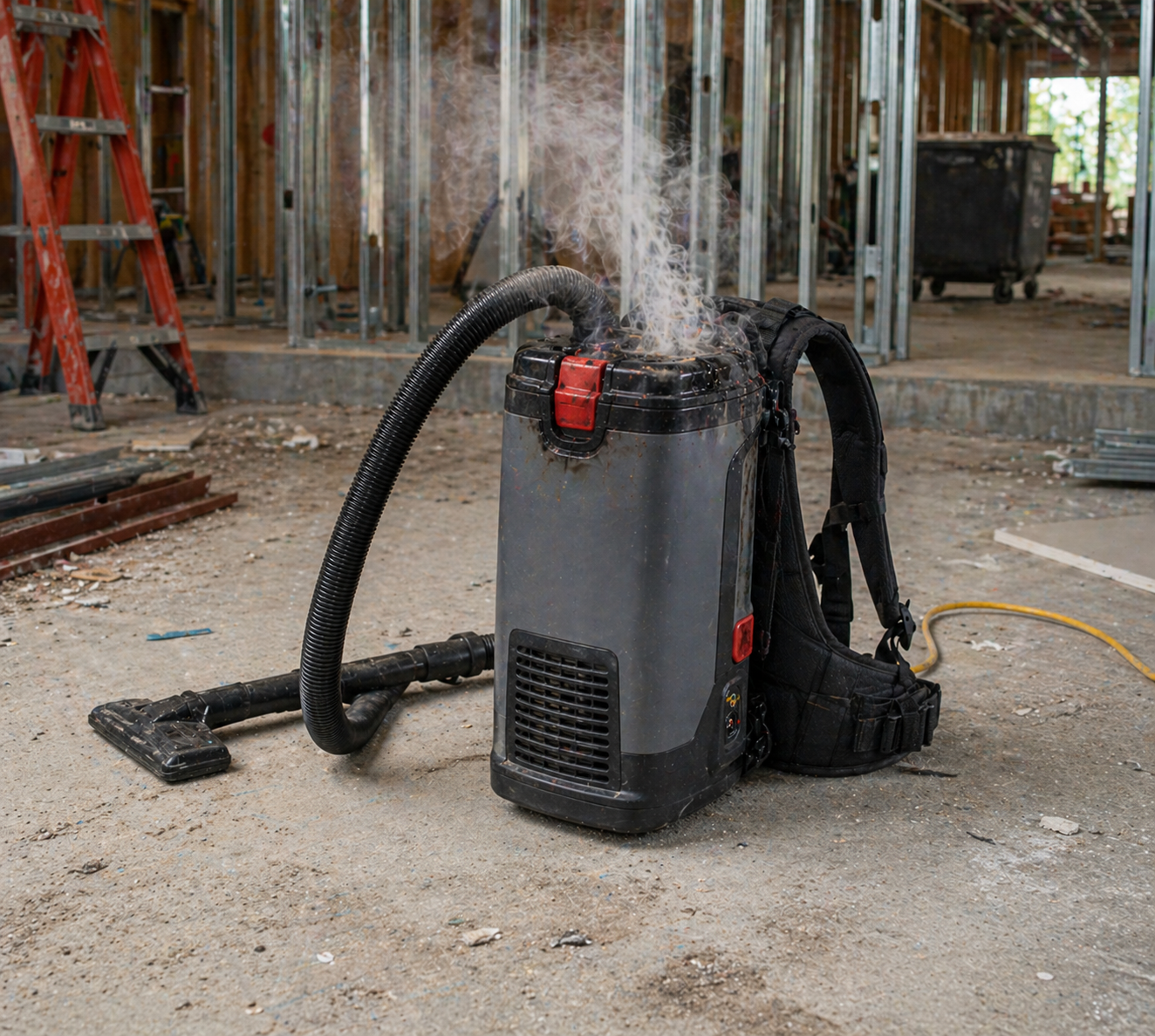
If your crews are reusing disposable backpack vacuum bags to stretch the budget, you're not saving money — you're paying for it in motor life, slower job times, and surprise replacement costs. We see it on every commercial job site.
The "saving money" trap
Disposable backpack vacuum bags run $10 to $20 each. So when a crew rips through a few a week, the math gets ugly fast — and the natural reaction is to make them last longer. Empty them out. Shake them off. Pop them back in.
It works. Sort of.
The problem is what you can't see: every reuse loads the bag fibers with fine dust, and that dust chokes the airflow that the motor was engineered to pull through it.
"It feels like a completely different machine."
That's what crews say the first time they switch to Pak Buddy. The reason isn't magic — it's airflow.
What restricted airflow actually does to your vacuum
A commercial, industrial, or cordless backpack vacuum is, at heart, an airflow pump. The motor is rated to move a specific volume of air through a specific resistance. When you clog the bag:
- The motor works harder to pull the same air
- It runs hotter because cooling air is part of the airflow path
- It draws more amperage — which on cordless backpack vacuums shortens runtime per battery
- The bearings, brushes, and impeller all see more stress per minute of run-time
Multiply that across a crew that's running 6–8 hours a day, 5 days a week, and you've turned a $400–$800 piece of equipment into a 12-month consumable instead of the 4–6 year asset it should be.
The hidden costs nobody adds up
When a backpack vacuum motor fails mid-job, the cost isn't just the repair invoice. It's:
| Cost | What it actually is |
|---|---|
| Motor replacement | $150–$400 in parts + labor, per machine |
| Lost productivity | A crew standing around waiting for a swap |
| Job timeline slip | A vacuum-dependent job stalls on a single machine |
| Premature fleet replacement | Buying new machines 2–3 years earlier than budgeted |
| Disposable bag spend | $10–$20 × frequency × every crew, every week |
Add that up across even a small fleet and the "savings" from reusing bags is dwarfed many times over.
Disposable bag vs. Pak Buddy — what's actually different
A disposable paper bag is one chamber. Air, dust, and debris all share the same path. As that path fills, airflow collapses. There's no way around it.
Pak Buddy uses a patented 2-chamber design that separates the air path from the debris path. Debris drops into its chamber; air keeps moving freely through its own. Suction stays consistent from the first sweep to the last.
It's the same principle that separates cheap workshop vacs from professional dust extractors — applied to the backpack vacuum bag itself.
What that means on the job
- No mid-job suction drop. Crews stay in flow instead of stopping to swap bags.
- Less heat in the motor housing. Motors that don't overheat last dramatically longer.
- No ongoing disposable bag spend. One Pak Buddy, used over and over.
- Less landfill waste. A single Pak Buddy replaces hundreds of disposables a year per machine.
"But the bags only cost $15 each…"
That's the trap. It's not the per-bag cost — it's the cost of what reused bags do to the rest of your operation. The slow jobs, the heat-killed motors, the unplanned downtime.
Pak Buddy is engineered to replace 7½ in. to 9 in. disposable bags in commercial, industrial, and cordless backpack vacuums — the same machines your crews are already using. No retraining. No new fleet. Just better airflow and lower running cost.
The bottom line
If your crews are reusing disposable backpack vacuum bags, you already know the suction loss is real. What you might not have realized is how much that single decision is silently costing across motor life, productivity, and fleet replacement.
Replacing disposables with a reusable Pak Buddy isn't a "nice to have." For any operation running commercial backpack vacuums on real job sites, it's a financial decision — one that usually pays for itself the first month.
Ready to stop killing your motors? See Pak Buddy →